In rallying, every piece of equipment contributes to the driver's safety, and the helmet is no exception. Choosing between a model Jet (open) or integral (closed) means evaluating different aspects related to the race conditions.
If you’re unsure which of the two types to choose, this guide will help you identify the strengths of each model and make an informed choice that’s right for your races.
Fit comes first
The first thing to consider, even before choosing a model, is the fit.
A helmet that is the wrong size is uncomfortable and compromises safety. To ensure maximum protection and concentration, the helmet must fit snugly around the head, without creating excessive pressure points or causing the head to move abnormally.
For this reason, it is essential Always check the size guides from manufacturers (such as Bell, OMP, Sparco) and measure the circumference of your head accurately before making a purchase.
Furthermore, for long rally stages, it is essential to choose helmets with liners made from breathable and hypoallergenic materials, preferably removable and washable.
The full-face helmet
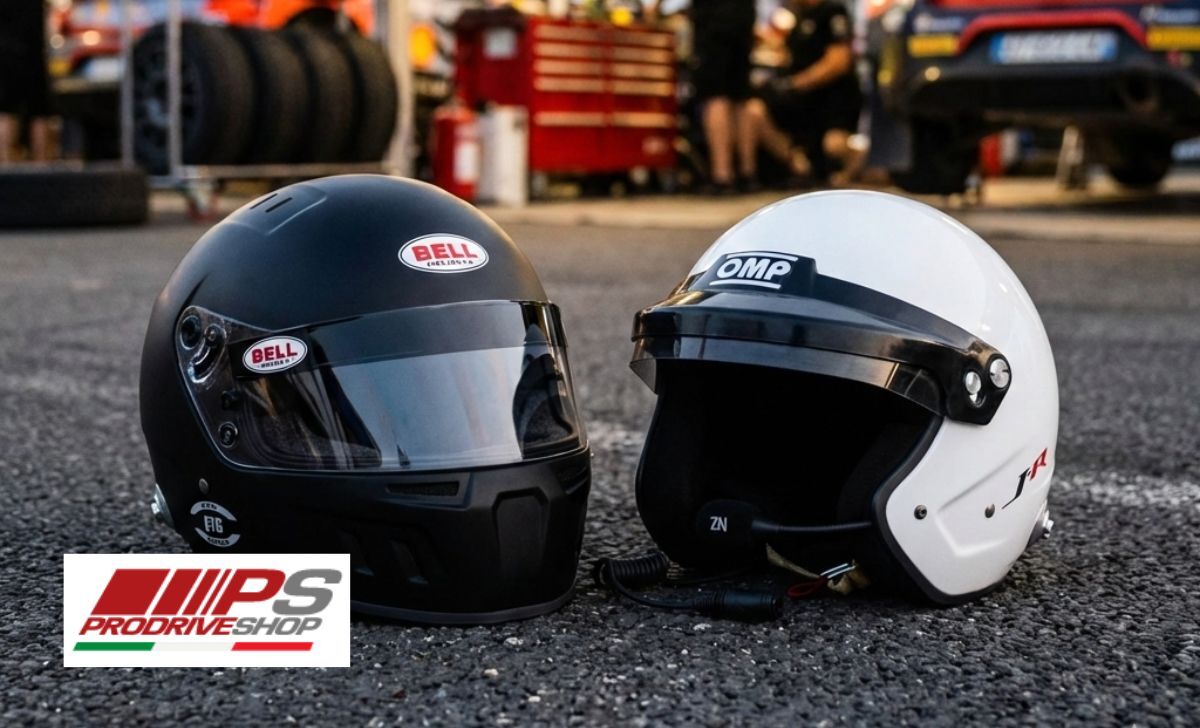
The full-face helmet offers the more comprehensive protection, completely covering the head, face and chin. There are several benefits:
- Comprehensive security: It offers maximum protection in the event of an impact, which is a key factor.
- Total isolation: The enclosed design provides excellent protection against dust, stones, mud and debris kicked up by the tyres.
- Noise reduction: It significantly reduces engine noise and external ambient noise. This helps to reduce auditory fatigue and makes it easier to understand the intercom commands (albeit in a more muffled way).
The main drawback relates to the heat, as it tends to be warmer in hot weather, although modern models are fitted with advanced ventilation systems.
The Jet (Open-Face) helmet
The Jet helmet It leaves the face completely uncovered and gives a greater sense of freedom. The advantages of this type of helmet are:
- Natural communication: The absence of a chin guard allows the rider’s and navigator’s voices to reach the intercom microphone more directly and naturally.
- Better ventilation: The front opening provides excellent ventilation for the face, which is a great advantage on summer stages or in very hot cockpits.
The intercom: the heart of communication in rallying
Regardless of the model chosen (Jet or Integrale), in rallying the functionality of the’intercom It is vital. That is why it is essential to ensure you choose helmets that incorporate (or are easily adapted for) a intercom system high quality.
Rally-specific helmets are, in fact, fitted with:
- Built-in headphones: Slim speakers, well positioned within the upholstery.
- Noise-cancelling microphone: essential for isolating the driver’s voice from engine and transmission noise, ensuring that the instructions are clear.
- Connectivity: With regard to this last point, it is important to check that the helmet’s connection is compatible with the central intercom unit (control unit) used in the car.
The final choice between a jet helmet and a full-face helmet.
In conclusion, the final decision between a jet helmet and a full-face helmet comes down to striking a balance between safety and specific functionality: if absolute protection and insulation are your priority, choose this helmet integral; if natural ventilation and maximum airflow in a warmer environment are essential, choose this model Jet.
Bell Omp Sparco full-face helmets