In the world of motorsport, safety It's not just about the helmet and clothing. Inside a racing car, one of the most critical risks is’Fire, especially after impacts, fuel leaks or mechanical overheating. For this reason, the Fire suppression systems they represent a fundamental element of racing setups, often mandatory by regulation.
Understanding how they work and what they are used for helps us realise why they are not just a simple accessory, but a genuine active protection system.
What is meant by a fire-extinguishing system?
A fire-extinguishing system for racing It is a system designed to quickly extinguish a fire that is just starting, either inside or outside the passenger compartment.
Unlike traditional portable fire extinguishers, these systems are designed to take immediate action, even in emergency situations where the pilot does not have the time or the opportunity to take manual control.
Fixed and portable fire extinguishers: two complementary approaches
In motorsport, the operation of a fire-extinguishing system It varies depending on the type installed, but the aim remains the same: to take action as quickly as possible to contain a fire outbreak.
Fixed fire-extinguishing systems
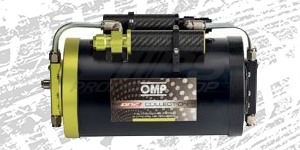
The fixed installations They are designed for immediate and coordinated action. The system consists of a cylinder containing the extinguishing agent, connected to a network of pipes and nozzles positioned near the areas most at risk, such as engine compartment, passenger compartment and fuel tank area.
It is activated manually via a control accessible to the pilot or, in some configurations, automatically. Once activated, the extinguishing agent is released simultaneously at several locations, making it possible to limit the spread of the fire in the early stages, when the situation can still be brought under control.
Portable fire extinguishers
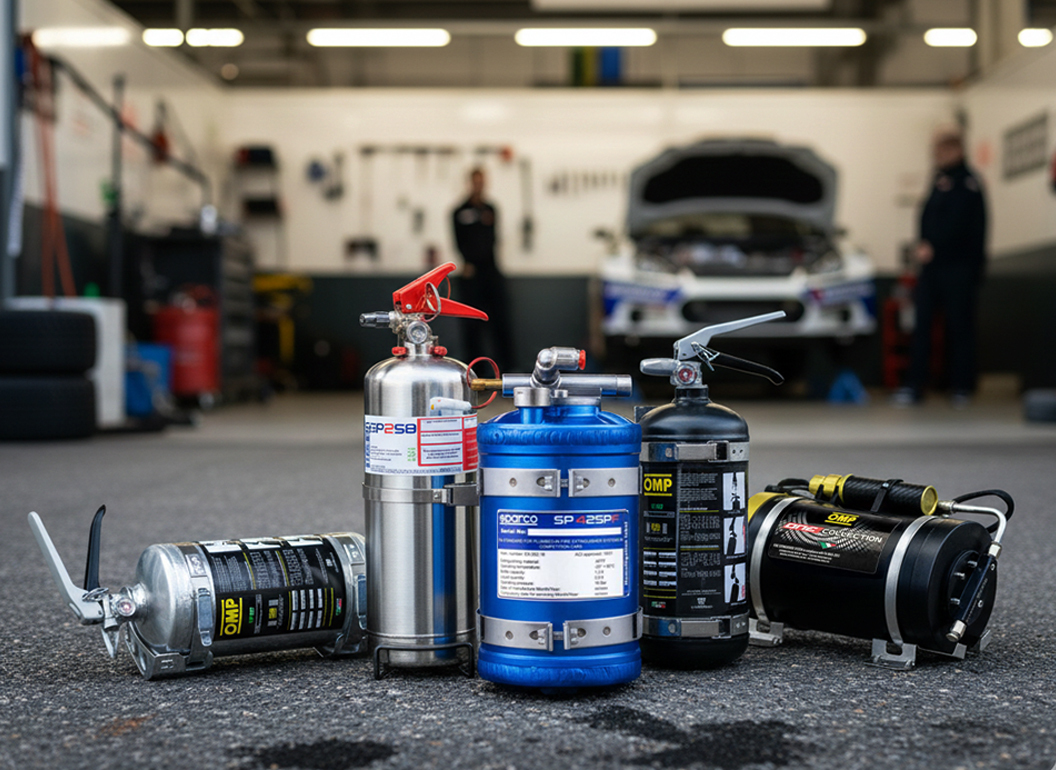
The portable fire extinguishers Instead, they operate entirely manually. They are operated by the pilot or ground crew and allow for a iTargeted work on a specific area of the vehicle or a fire starting outside the passenger compartment.
This type is particularly useful during servicing, in the paddock or in situations where it is not necessary to activate a fixed system, but where a quick and direct response is required.
The aim of these systems is not just to extinguish the flames, but to contain the fire in the very first few seconds, drastically reducing the risks to the driver and minimising damage to the car.
The importance of fire-extinguishing systems, beyond the regulations
Many drivers fit a fire-extinguishing system because it is required by the regulations, but in reality, its usefulness goes far beyond mere compliance.
A fire in a racing car It accelerates much more rapidly than a road vehicle, due to:
- lightweight and flammable materials
- high operating temperatures
- presence of fuel and pressurised oils
In such cases, It is vital to take immediate action and a fire-extinguishing system buys valuable time, enabling the driver to exit the cockpit immediately in greater safety.
A key element of the racing set-up
A fire-extinguishing system is one of those systems that you hope you’ll never have to activate, but which prove crucial when the situation demands it. It has no impact on lap times or performance, but provides a vital safeguard in most critical moments of a race.
In motorsport, safety is not an afterthought, but an integral part of the car’s design. That is why the Fire suppression systems are regarded as being on a par with the chassis, suspension and brakes: essential components, designed to protect the rider and enable them to tackle the race with greater awareness and control.

FIA-approved handheld fire extinguishers